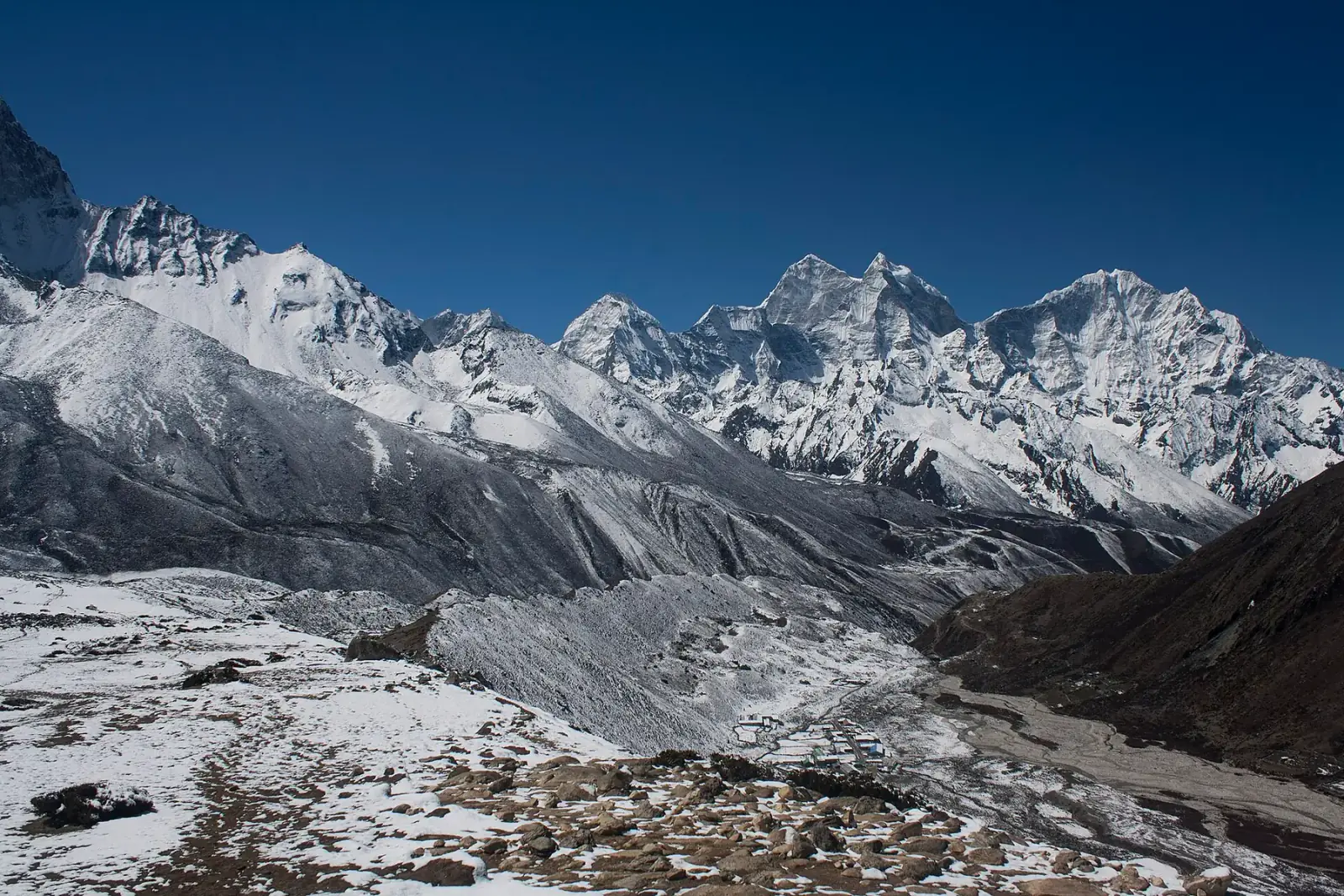
Photo: Niklassletteland · CC BY-SA 3.0 · Wikimedia Commons · resized; shared under the same licence
Everest Base Camp
Stand at the foot of the world's highest mountain
The Everest Base Camp trek is the ultimate Himalayan adventure. Over 14 days, you will walk through Sherpa villages, ancient monasteries, and glacial valleys before arriving at Everest Base Camp at 5,364 meters. This is not just a trek — it is a pilgrimage through some of the most dramatic mountain scenery on Earth.
Book Everest Base Camp
No obligation. Or call +977-9849998031
Route map
Waypoints
- Day 1 — Lukla 2,840 m
- Day 1 — Phakding 2,610 m
- Day 2 — Namche Bazaar 3,440 m
- Day 3 — Namche Bazaar 3,440 m
- Day 4 — Tengboche 3,867 m
- Day 5 — Dingboche 4,410 m
- Day 6 — Nangkartshang Peak 5,073 m
- Day 6 — Dingboche 4,410 m
- Day 7 — Lobuche 4,910 m
- Day 8 — Gorak Shep 5,164 m
- Day 8 — Everest Base Camp 5,364 m
- Day 9 — Kala Patthar 5,545 m
- Day 9 — Pheriche 4,371 m
- Day 10 — Namche Bazaar 3,440 m
- Day 11 — Lukla 2,840 m
Elevation profile
| Day | Place | Altitude | Gain from previous night |
|---|---|---|---|
| 1 | Lukla | 2,840 m | first night |
| 1 | Phakding | 2,610 m | -230 m |
| 2 | Namche Bazaar | 3,440 m | +830 m |
| 3 | Namche Bazaar | 3,440 m | 0 m |
| 4 | Tengboche | 3,867 m | +427 m |
| 5 | Dingboche | 4,410 m | +543 m |
| 6 | Dingboche | 4,410 m | 0 m |
| 7 | Lobuche | 4,910 m | +500 m |
| 8 | Gorak Shep | 5,164 m | +254 m |
| 9 | Pheriche | 4,371 m | -793 m |
| 10 | Namche Bazaar | 3,440 m | -931 m |
| 11 | Lukla | 2,840 m | -600 m |
Terrain elevation interpolated between waypoints by SRTM30m — not the route's sourced altitudes. May read above or below maxAltitude/maxSleepAltitude (both cited, manual figures); render or label accordingly, do not treat as the same number.
Acclimatisation
2 nights on this itinerary gain more than 500 m of sleeping altitude: Namche Bazaar (+830 m), Dingboche (+543 m). Each of its 2 rest days follows the gain that earned it. The highest night is 5,164 m.
| Day | Sleeping at | Altitude | Gain from previous night | Rest day |
|---|---|---|---|---|
| 1 | Lukla | 2,840 m | first night | |
| 1 | Phakding | 2,610 m | -230 m | |
| 2 | Namche Bazaar | 3,440 m | +830 m (above the 500 m guideline) | |
| 3 | Namche Bazaar | 3,440 m | 0 m | Rest day — follows the gain above |
| 4 | Tengboche | 3,867 m | +427 m | |
| 5 | Dingboche | 4,410 m | +543 m (above the 500 m guideline) | |
| 6 | Dingboche | 4,410 m | 0 m | Rest day — follows the gain above |
| 7 | Lobuche | 4,910 m | +500 m | |
| 8 | Gorak Shep | 5,164 m | +254 m | |
| 9 | Pheriche | 4,371 m | -793 m | |
| 10 | Namche Bazaar | 3,440 m | -931 m | |
| 11 | Lukla | 2,840 m | -600 m |
Cited to the Wilderness Medical Society Clinical Practice Guidelines (2024): above 3,000 m, do not increase sleeping elevation by more than 500 m per day, and take a rest day every 3–4 days. WMS itself notes that terrain often makes strict adherence impossible.
This is itinerary information, not medical advice, and not clearance to trek. Acclimatisation varies between individuals.
Your trip, day by day — all 14 days, travel included
Every day of the 14-day trip in the order it happens, including the flights, drives and rest days that have no walking stage. These are trip day numbers. The next section numbers walking days instead, starting again at 1, so a day number here and a walking day number there are not the same day.
- Day 1 of 14
Kathmandu — Arrival & Briefing
Arrive in Kathmandu. Meet your guide and fellow trekkers at the welcome briefing. Gear check, permit verification, and a traditional Nepali dinner to kick off the adventure.
- Day 2 of 14
Fly to Lukla — Trek to Phakding
Take the spectacular mountain flight to Lukla (2,840m) and begin the trek with a gentle walk to Phakding (2,610m). Pass through pine forests and cross your first suspension bridges over the Dudh Koshi river.
- Day 3 of 14
Phakding to Namche Bazaar
Trek to the legendary Sherpa capital of Namche Bazaar (3,440m). The trail follows the river valley before a steep climb to Namche, where you get your first glimpse of Everest on a clear day.
- Day 4 of 14
Acclimatization Day in Namche
A critical rest day for altitude adjustment. Explore Namche's bustling market, visit the Sherpa Culture Museum, or take a short hike to the Everest View Hotel for stunning panoramic views of Everest, Lhotse, and Ama Dablam.
- Day 5 of 14
Namche to Tengboche
Trek through rhododendron forests to Tengboche (3,867m), home to the largest monastery in the Khumbu region. The afternoon offers spectacular views of Everest, Nuptse, and Ama Dablam from the monastery grounds.
- Day 6 of 14
Tengboche to Dingboche
Continue climbing through thinning forests into the alpine zone. Arrive at Dingboche (4,410m) in a wide valley flanked by towering peaks. The landscape shifts dramatically from lush forest to high-altitude desert.
- Day 7 of 14
Acclimatization Day in Dingboche
Another essential rest day. Optional hike to Nangkartshang Peak (5,073m) for incredible 360-degree views of Island Peak, Makalu, and the Lhotse wall. Your guide monitors everyone's health and acclimatization progress.
- Day 8 of 14
Dingboche to Lobuche
Trek past the memorial cairns at Thukla Pass to Lobuche (4,910m). The trail traverses the lateral moraine of the Khumbu Glacier. The air is noticeably thinner now and the pace deliberately slower.
- Day 9 of 14
Lobuche to Gorak Shep — Everest Base Camp
The big day. Trek to Gorak Shep (5,164m), drop your bags, and make the final push to Everest Base Camp (5,364m). Stand where mountaineering legends have stood, surrounded by the Khumbu Icefall and the south face of Everest.
- Day 10 of 14
Gorak Shep to Kala Patthar — Descend to Pheriche
Pre-dawn climb to Kala Patthar (5,545m) for the most iconic sunrise view of Mount Everest. Then begin the descent to Pheriche (4,371m), where the thicker air feels like a luxury after days at altitude.
- Day 11 of 14
Pheriche to Namche Bazaar
A long but rewarding descent back to Namche Bazaar. The return through familiar landscapes feels different — you are returning as someone who has stood at the base of the world's highest peak.
- Day 12 of 14
Namche to Lukla
Final trekking day back to Lukla. Celebrate the completion of the trek with your team over a farewell dinner. Reflect on the journey and the friendships forged on the trail.
- Day 13 of 14
Fly Lukla to Kathmandu
Morning flight back to Kathmandu. Free afternoon for shopping, sightseeing, or simply relaxing after two weeks on the trail. Optional group dinner in Thamel.
- Day 14 of 14
Departure Day
Transfer to Tribhuvan International Airport for your onward journey. Alternatively, extend your stay to explore Kathmandu Valley, Bhaktapur, or Patan.
Walking days on the mapped route — 11 days of sourced altitudes
Numbered by walking day: walking day 1 is the first day with a mapped stage. Every altitude below is a waypoint from this route's own sources, listed at the foot of the page.
- Lukla 2,840 m
overnight
Tenzing–Hillary airstrip. Flights shift to Ramechhap in peak season.
- Phakding 2,610 m
overnight
Net descent on day one — deliberate.
- Namche Bazaar 3,440 m
overnight
830 m gain. The first night above 3,000 m.
- Namche Bazaar 3,440 m
overnight
Acclimatization day. Walk high to Hotel Everest View, sleep low.
- Tengboche 3,867 m
overnight
Monastery. 427 m gain.
- Dingboche 4,410 m
overnight
543 m gain — above the 500 m guideline.
- Nangkartshang Peak 5,073 m
day stop
Acclimatization day hike from Dingboche, not slept at. OSM node 2950781581 (natural=peak, name="Nangkartshang") carries ele=5073, 10m below the published 5,083m figure — within this project's normal source-disagreement range.
- Dingboche 4,410 m
overnight
Second acclimatization day, placed after the largest gain so far.
- Lobuche 4,910 m
overnight
500 m gain. Thukla pass and the memorials en route. OSM's node carries ele=4910, matching ebc-gokyo-cho-la and three-passes; this route's earlier 4,940 m was the outlier.
- Gorak Shep 5,164 m
overnight
The highest night on the route.
- Everest Base Camp 5,364 m
day stop
Day trip from Gorak Shep. Nobody sleeps here. OSM node 5225912921 (tourism=camp_site); its ele=5364 tag independently corroborates the published altitude.
- Kala Patthar 5,545 m
day stop
Pre-dawn. The highest point touched, not slept at. Wikipedia's infobox treats 5,644.5 m as Kala Patthar's most authoritative figure while also listing the commonly-published 5,545–5,550 m range we use here; not reconciled to a single source. Does not affect the acclimatization read (sleep: false).
- Pheriche 4,371 m
overnight
Descent begins. HRA aid post here.
- Namche Bazaar 3,440 m overnight
- Lukla 2,840 m
overnight
Buffer days 12–14 absorb flight delays, which are common.
The remaining 3 days of this 14-day trip cover travel to and from the trailhead, and buffer time for delays en route — the specifics vary by route.
Permits
| Permit | Fee | Verified |
|---|---|---|
| Sagarmatha National Park Entry | NPR 3,000 | Verified 2026-09-07 |
| Khumbu Pasang Lhamu Rural Municipality Fee | NPR 3,000 | Verified 2026-09-07 |
Cost breakdown
- Permits (NPR)
- NPR 6,000
Permit fees above are the only figures on this page we have re-verified against the issuing authority; the route's itinerary and altitudes are built from the sources listed further down this page, not independently re-verified with one. Other trip costs — teahouse accommodation, a guide, a porter, and flights where the route requires one — vary by season, operator and party size and are not itemised here.
When to go
Month-by-month fit for Everest Base Camp, based on this route's own best-months window.
- Jan avoid
- Feb shoulder
- Mar best
- Apr best
- May best
- Jun shoulder
- Jul avoid
- Aug avoid
- Sep shoulder
- Oct best
- Nov best
- Dec shoulder
Everest Base Camp — Frequently Asked Questions
How hard is the Everest Base Camp trek?
What is the best time to trek to Everest Base Camp?
Do I need previous trekking experience?
Is altitude sickness a risk?
What do I need to pack?
Sources
Ready to book Everest Base Camp?
14 days in the Everest (Khumbu) region, highest night at 5,164 m, from USD 1,200.