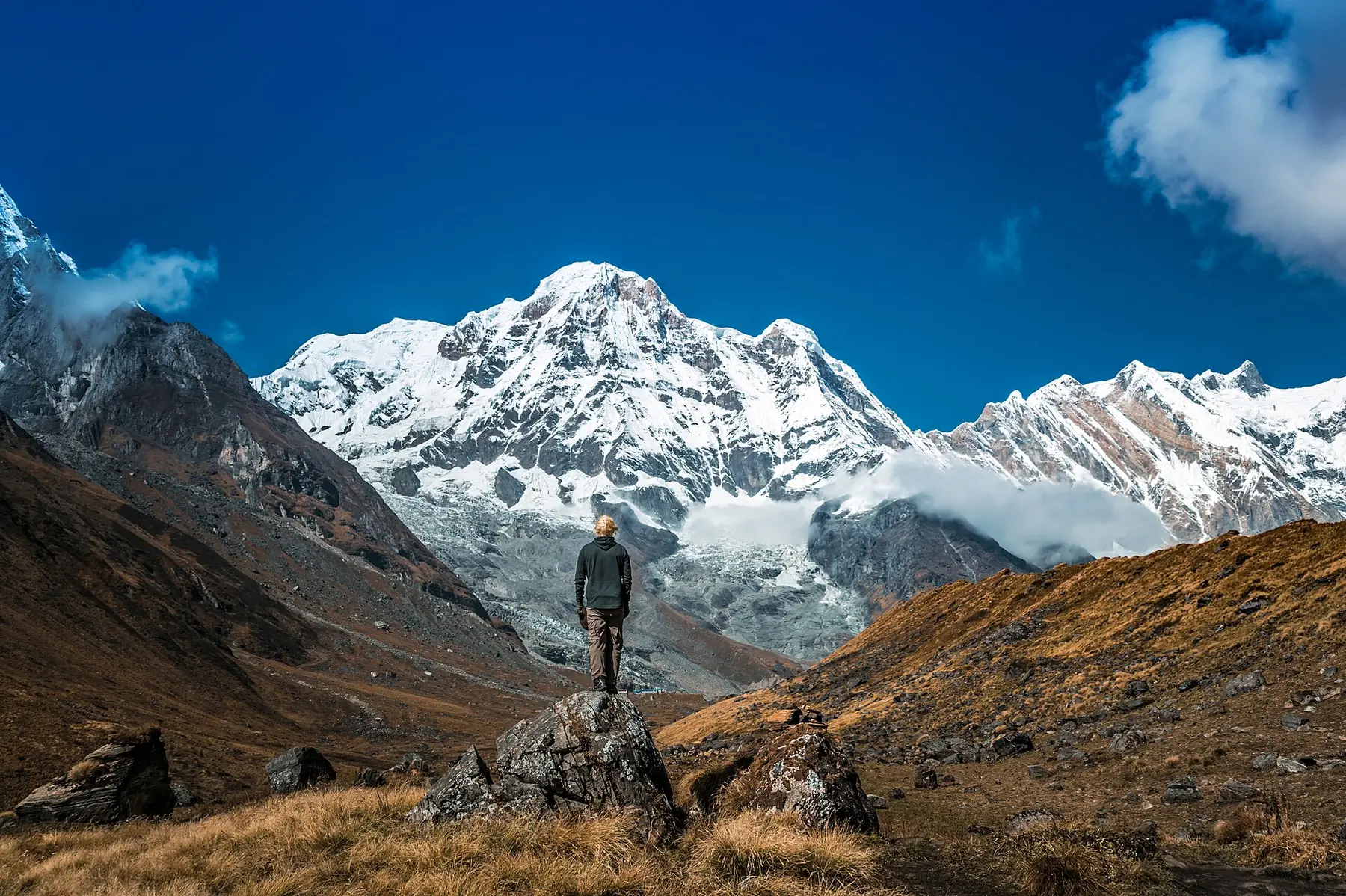
Photo: Arto Marttinen wandervisions · CC0 · Wikimedia Commons
Annapurna Base Camp
Into the heart of the Annapurna Sanctuary
The Annapurna Base Camp (ABC) trek is one of Nepal's classic treks, leading you deep into the Annapurna Sanctuary — a natural amphitheater of towering peaks. Over 10 days, you will trek through terraced rice paddies, dense bamboo and rhododendron forests, and Gurung villages before entering the glacial sanctuary at 4,130 meters, surrounded on all sides by Annapurna I (8,091m), Annapurna South (7,219m), Machhapuchhre (6,993m), Hiunchuli (6,441m), and a ring of other Himalayan giants. The 360-degree panorama from Base Camp is one of the most spectacular viewpoints in the entire Himalayan range.
Book Annapurna Base Camp
No obligation. Or call +977-9849998031
Route map
Waypoints
- Day 1 — Ghandruk 1,940 m
- Day 2 — Chhomrong 2,170 m
- Day 3 — Bamboo 2,310 m
- Day 4 — Deurali 3,230 m
- Day 5 — Annapurna Base Camp 4,130 m
- Day 6 — Bamboo 2,310 m
- Day 7 — Jhinu Danda 1,780 m
- Day 8 — Birethanti 1,025 m
Elevation profile
| Day | Place | Altitude | Gain from previous night |
|---|---|---|---|
| 1 | Ghandruk | 1,940 m | first night |
| 2 | Chhomrong | 2,170 m | +230 m |
| 3 | Bamboo | 2,310 m | +140 m |
| 4 | Deurali | 3,230 m | +920 m |
| 5 | Annapurna Base Camp | 4,130 m | +900 m |
| 6 | Bamboo | 2,310 m | -1,820 m |
| 7 | Jhinu Danda | 1,780 m | -530 m |
| 8 | Birethanti | 1,025 m | -755 m |
Terrain elevation interpolated between waypoints by SRTM30m — not the route's sourced altitudes. May read above or below maxAltitude/maxSleepAltitude (both cited, manual figures); render or label accordingly, do not treat as the same number.
Acclimatisation
2 nights on this itinerary gain more than 500 m of sleeping altitude: Deurali (+920 m), Annapurna Base Camp (+900 m). It schedules no rest day at altitude. The highest night is 4,130 m.
| Day | Sleeping at | Altitude | Gain from previous night | Rest day |
|---|---|---|---|---|
| 1 | Ghandruk | 1,940 m | first night | |
| 2 | Chhomrong | 2,170 m | +230 m | |
| 3 | Bamboo | 2,310 m | +140 m | |
| 4 | Deurali | 3,230 m | +920 m (above the 500 m guideline) | |
| 5 | Annapurna Base Camp | 4,130 m | +900 m (above the 500 m guideline) | |
| 6 | Bamboo | 2,310 m | -1,820 m | |
| 7 | Jhinu Danda | 1,780 m | -530 m | |
| 8 | Birethanti | 1,025 m | -755 m |
Cited to the Wilderness Medical Society Clinical Practice Guidelines (2024): above 3,000 m, do not increase sleeping elevation by more than 500 m per day, and take a rest day every 3–4 days. WMS itself notes that terrain often makes strict adherence impossible.
This is itinerary information, not medical advice, and not clearance to trek. Acclimatisation varies between individuals.
Your trip, day by day — all 10 days, travel included
Every day of the 10-day trip in the order it happens, including the flights, drives and rest days that have no walking stage. These are trip day numbers. The next section numbers walking days instead, starting again at 1, so a day number here and a walking day number there are not the same day.
- Day 1 of 10
Pokhara to Nayapul — Trek to Ghandruk (1,940m)
Drive from Pokhara to Nayapul (1.5 hours) and begin trekking through rice paddies along the Modi Khola. Climb stone steps to the beautiful Gurung village of Ghandruk with views of Annapurna South and Machhapuchhre. Walking time: 5-6 hours.
- Day 2 of 10
Ghandruk to Chhomrong (2,170m)
Trek along a scenic ridge trail with mountain views, then descend to the Kimrong Khola before climbing to Chhomrong, the last permanent settlement before the Sanctuary. This large Gurung village offers great teahouses and supplies. Walking time: 5-6 hours.
- Day 3 of 10
Chhomrong to Bamboo (2,310m)
Descend the long stone staircase from Chhomrong to the Chhomrong Khola river, then climb through Sinuwa before entering dense bamboo forest. The trail descends to Bamboo, a small settlement in a narrow valley. Walking time: 4-5 hours.
- Day 4 of 10
Bamboo to Deurali (3,230m)
Trek through bamboo groves into rhododendron forest, passing Himalaya Hotel and Hinku Cave. The valley narrows as you approach Deurali. Avalanche debris from the surrounding peaks is visible on the trail — a reminder of the power of the mountains. Walking time: 5-6 hours.
- Day 5 of 10
Deurali to Annapurna Base Camp (4,130m)
The trail crosses the avalanche-prone Hinku Valley into Machhapuchhre Base Camp, the gateway to the Sanctuary. Continue to Annapurna Base Camp at 4,130m. The panorama opens in all directions — you are standing in a natural amphitheater of 8,000m peaks. Walking time: 5-6 hours.
- Day 6 of 10
Explore ABC — Descend to Bamboo (2,310m)
Watch sunrise illuminate the Sanctuary walls. Spend the morning exploring, photographing, and absorbing the scale of the mountains. Begin the descent, retracing the trail back to Bamboo. The thicker air and warmer temperatures below feel luxurious. Walking time: 6-7 hours.
- Day 7 of 10
Bamboo to Chhomrong (2,170m)
Climb back out of the valley to Chhomrong. The familiar trail offers new perspectives on the descent. Rest in Chhomrong's comfortable teahouses with hot showers — a treat after the basic facilities at altitude. Walking time: 5-6 hours.
- Day 8 of 10
Chhomrong to Jhinu Danda (1,780m)
Descend through terraced hillsides to Jhinu Danda. The highlight is the natural hot spring by the Modi Khola river — a perfect way to soak tired muscles after days of mountain walking. Walking time: 3-4 hours.
- Day 9 of 10
Jhinu Danda to Nayapul — Drive to Pokhara
Final trek to Nayapul (3-4 hours) through terraced fields and small villages. Drive back to Pokhara. Free afternoon to relax by Phewa Lake or explore the city. Farewell dinner with the team.
- Day 10 of 10
Pokhara — Departure
Fly or drive to Kathmandu, or extend your stay in Pokhara. Options include paragliding, boating on Phewa Lake, or visiting the World Peace Pagoda. Airport transfer for onward journey.
Walking days on the mapped route — 8 days of sourced altitudes
Numbered by walking day: walking day 1 is the first day with a mapped stage. Every altitude below is a waypoint from this route's own sources, listed at the foot of the page.
- Ghandruk 1,940 m
overnight
Drive from Pokhara to Nayapul, trek via Birethanti. Large Gurung village.
- Chhomrong 2,170 m
overnight
Gateway to the Modi Khola gorge and the Annapurna Sanctuary proper.
- Bamboo 2,310 m
overnight
Via Sinuwa (2,340m), the official entrance to the Sanctuary. Named for the bamboo forest around the lodges.
- Deurali 3,230 m
overnight
Via Dovan (2,600m) and Himalaya (2,700m). Avalanche-prone section above Himalaya — do not linger.
- Annapurna Base Camp 4,130 m
overnight
Via Machhapuchhre Base Camp (~3,700m, not separately resolved — see notes). At the foot of Annapurna I's south face, inside the Sanctuary.
- Bamboo 2,310 m
overnight
Descent begins.
- Jhinu Danda 1,780 m
overnight
Natural hot springs by the Modi Khola.
- Birethanti 1,025 m
overnight
Roadhead near Nayapul. Jeep/bus to Pokhara.
The remaining 2 days of this 10-day trip cover travel to and from the trailhead, and buffer time for delays en route — the specifics vary by route.
Permits
| Permit | Fee | Verified |
|---|---|---|
| Annapurna Conservation Area Permit | NPR 3,000 | Verified 2026-09-07 |
Cost breakdown
- Permits (NPR)
- NPR 3,000
Permit fees above are the only figures on this page we have re-verified against the issuing authority; the route's itinerary and altitudes are built from the sources listed further down this page, not independently re-verified with one. Other trip costs — teahouse accommodation, a guide, a porter, and flights where the route requires one — vary by season, operator and party size and are not itemised here.
When to go
Month-by-month fit for Annapurna Base Camp, based on this route's own best-months window.
- Jan avoid
- Feb shoulder
- Mar best
- Apr best
- May best
- Jun shoulder
- Jul avoid
- Aug shoulder
- Sep best
- Oct best
- Nov best
- Dec shoulder
Annapurna Base Camp — Frequently Asked Questions
How difficult is the Annapurna Base Camp trek?
When is the best time for the ABC trek?
Is the ABC trek suitable for beginners?
How does ABC compare to Everest Base Camp?
Is there avalanche risk in the Annapurna Sanctuary?
Sources
Ready to book Annapurna Base Camp?
10 days in the Annapurna region, highest night at 4,130 m, from USD 800.